
The Social Inclusion Framework
Social inclusion refers to the process of improving the terms under which individuals and groups participate in society by enhancing their ability, opportunity, and dignity.
In InCUBE, social inclusion focuses on improving renovation processes so that they are technically viable, sustainable, and socially equitable. To operationalise this approach, the Social Inclusion Framework has been developed, comprising six key dimensions: end-user engagement, accessibility, affordability, stakeholder engagement, health and safety, and equal employment opportunities and conditions. These dimensions are intended to be considered across four key target groups: end users, internal stakeholders, external stakeholders, and construction workers.
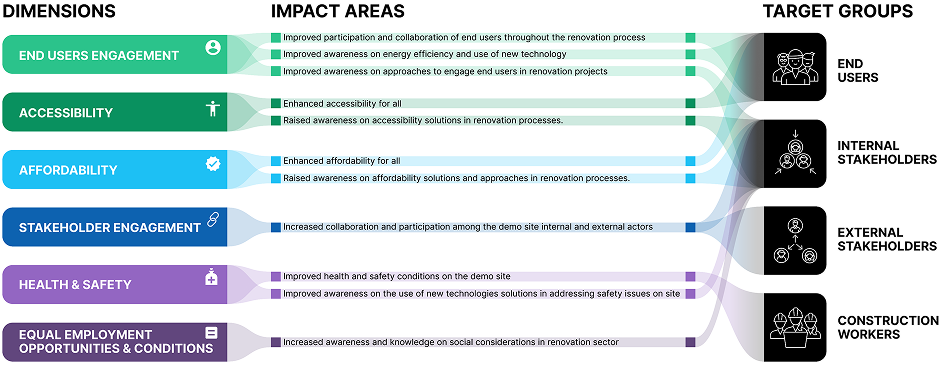
The Digital Dashboard showcases data related to the Social Inclusion Framework, both in terms of research and recommendations for enhancing the capability of InCUBE partners to effectively address and leverage social inclusion during the project implementation and in the sector. Data is organized in the following sections:
Stakeholders mapping
Browse the map showing the network of internal and external stakeholders in each demo site.
Expected outcomes
Explore the expectations about the aspects of social inclusion that could be addressed within each demo site.
End user analysis
Read about the analysis of the characteristics and perceptions of end users of each demo site.
Renovation blueprints
Learn from our collection of tailored recommendations and operational tips that each demo site will implement during the renovation to improve social inclusion.